Your next client has already asked AI about you. The question is what answer they got. “Which law firm is best for partner disputes?”, “Is this company reliable?”, “Who is the best cloud security vendor in Israel?” AI answers these questions with confidence, even when its information is old, partial or wrong. It does not call you to check. It assembles an answer from what it finds online, and what is online is your responsibility.
- Language models build a picture of a company from stories, forums, reviews and databases, and when information is missing they may fill the gap incorrectly
- In the Air Canada case, a tribunal ruled in 2024 that the company was responsible for wrong information its chatbot gave a customer
- Wikipedia, YouTube and Reddit were the most cited sources in Google’s AI summaries, together making up 15% of links
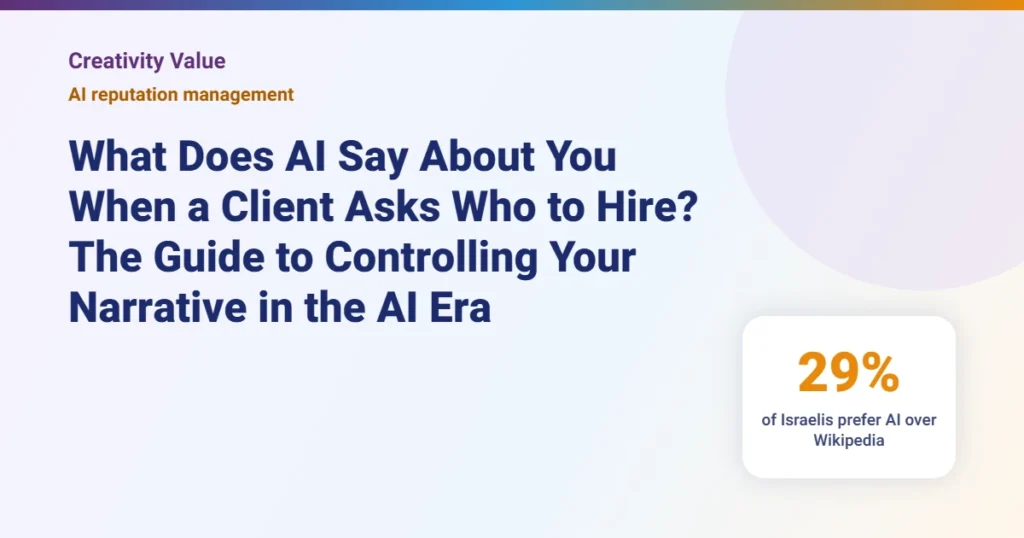
- In Israel, 29% of the public said they tend to prefer AI tools over Wikipedia as a source of information
- A media shield, a steady flow of positive and authoritative mentions, is the only way to control the narrative over time
How does a language model form an “opinion” about a company?
A language model has no opinion. It has probabilities. It learns from everything written about your company: a story from five years ago, a forum thread, one angry review, an outdated database entry. When it searches in real time, it retrieves the available sources and summarizes them. If the sources are old, the summary is old. If there are few sources, each one, including the negative ones, carries more weight. And if there is not enough information, the model may “complete” details that do not exist, a phenomenon called hallucination.
| Risk | What it looks like | Where it comes from |
|---|---|---|
| Outdated information | A discontinued service, an old price, a former CEO | Stories and pages never updated |
| Identity confusion | A review of a similarly named company attributed to you | Little distinguishing information about you |
| Hallucination | An award you never won, a client you never had | An information gap the model fills |
| Negative skew | One review dominates the answer | No balanced positive mentions |
| Absence | Competitors are recommended and you are not | No mentions in the sources the engine reads |
What happens when AI gets it wrong, and who is responsible?
The best-known case is Air Canada. A passenger asked the airline’s chatbot about a bereavement fare and received wrong information about the refund policy. In February 2024 the British Columbia Civil Resolution Tribunal ruled that the airline was responsible for what its chatbot said and rejected the argument that the bot was a “separate entity”. The case involved the company’s own bot, but the lesson is broader: from the customer’s point of view, what AI says about your brand is part of their experience with it.
With external engines like ChatGPT and Google you have no direct way to correct an answer. You have one lever: change the sources the engine reads.
The secrets of winning campaigns in the US
Large US companies are already setting up teams that monitor what AI engines say about them and work systematically on the sources. The recurring combination has these parts:
In-depth stories in legitimate outlets
Profiles and interviews in edited media are the source AI engines trust most. According to Muck Rack, 84% of citations come from earned media.
Objective comparison lists
When someone asks “who is best”, the engine looks for lists. Inclusion in independent, credible lists, not ones you wrote about yourself, raises the chance of being recommended.
Q&A content on your site
Pages that directly answer customers’ questions, with schema, prices and current facts, give the engine an official and accurate source.
Verified reviews
Active profiles on Google Business, Clutch and professional platforms, with real reviews and responses, serve as sources for comparison and buying questions.
Pew found that Wikipedia, YouTube and Reddit were the most cited sources in Google’s AI summaries. What is written about you on open platforms matters and cannot be ignored.
The management dilemma: wait, or build a media shield?
| Passive response | Media shield | |
|---|---|---|
| When you act | After something bad happens | Continuously, before you need it |
| What AI sees | One negative story and a few comments | Dozens of balanced, current mentions |
| Cost | Expensive, high-pressure crisis management | Ongoing, predictable investment |
| Outcome | Fixing it takes months | A negative event is absorbed in a wider context |
Research by SparkToro and Gumshoe.ai shows AI answers change almost every run. There is no single answer to fix. There is a distribution of answers, and the way to shift it is to increase the weight of positive, accurate sources. That is what a media shield does: a steady flow of stories, interviews, reviews and content that balances any one-off event.
- Publish fake reviews or “comparison” lists you wrote about yourself
- Flood the web with generic AI content that holds no real information
- Ignore negative reviews instead of responding to them factually
What an integrated process looks like in Israel
In Israel this is especially urgent. According to a survey by the Samuel Neaman Institute, Shenkar, Wikimedia Israel and the Israel Internet Association, 29% of Israelis said they tend to prefer AI tools over Wikipedia as a source of information, and many do not verify what they receive. For many people, what AI says about you in Hebrew is the truth.
At Creativity Value we have supported companies and business owners with reputation management and crisis communications since 2008. The difference today is that the first reader of every story is not only a customer. It is also the engine that will recommend you, or your competitors.
- Why AI Engines Ignore Your Website and How PR Makes You the First Answer in ChatGPT and Google
- The 4-Hour Window: How to Turn Breaking News Into a Direct Way Into AI Answers
- Why AI Engines Trust People More Than Logos: The Founder-Led PR Strategy of Top US CEOs
- The Click Is Dead, Long Live the Citation: How Smart Companies Cut Marketing Costs With PR and GEO
Frequently asked questions
Can I ask ChatGPT to correct information about me?
There is no direct mechanism to correct a single answer. The effective route is to fix the sources the engine reads, your site, profiles, databases and press coverage, and to add new, accurate sources.
What is an AI hallucination?
A situation where a language model presents wrong or invented information with full confidence, usually when it lacks reliable information on the topic.
How long does it take to change what AI says?
Engines with real-time search can reflect new sources within days to weeks. A consistent change in the overall picture usually builds over several months.
Do reviews really matter?
Yes. Review platforms serve as sources for comparison and buying questions, and having no reviews leaves the answer to others.
What do we do about an old negative story?
You do not erase history, but you balance it: respond factually, and over time build new, current and credible mentions that carry more weight in answers.
Want to know what AI says about you, and change it?
We will audit how AI describes your company and executives, fix the sources and build a media shield that protects your narrative.
Let’s talkOnline reputation managementSources
- Moffatt v. Air Canada, 2024 BCCRT 149, British Columbia Civil Resolution Tribunal, February 2024
- Pew Research Center, AI summaries in Google search, July 2025
- SparkToro and Gumshoe.ai, via Search Engine Land, 2026
- Muck Rack, What Is AI Reading?, May 2026
- Ahrefs, AI Overview Brand Visibility Factors, May 2025
- Samuel Neaman Institute, Shenkar, Wikimedia Israel and the Israel Internet Association, Wikipedia and AI use survey, via The Jerusalem Post
- Seer Interactive, AIO Impact on Google CTR, 2025
Last updated: November 2026
Want this kind of coverage for your company?
- ✓530+ media placements secured for clients in Israel and abroad
- ✓A team that came from business journalism, in the field since 2008
- ✓PR, podcasts and AI visibility under one roof
What Our Clients Say
Shoham is a pro. Period. He is determined, humble and always pushing boundaries. I met him through my podcast, and the way he pitched guests was different: he took the time to understand what really fits me, and it was clear he knows his clients in depth. Making him my go-to PR person was completely natural. I warmly recommend Shoham.

In just three months we generated very significant exposure in the leading media outlets: Globes, TheMarker, Mako and the leading podcasts in Israel. The PR activity made a real impact on our business and we received excellent feedback.

I warmly recommend Shoham to anyone looking for professional PR in finance and technology. He truly cares about his clients before, during and after the work. His professionalism is clear from the first meeting: he studies your field and niche in depth, asks the right questions and honestly presents the pros and cons of every direction. What matters most to him is your results, and he gets the best ones possible within the budget and in the shortest time imaginable.

For two years we worked with Sapir and Shoham on managing our social channels. Our exposure on social media and the connection between mortgage advisors and the association grew significantly. It was a very meaningful contribution.
The team created personal branding for our agents that few financial planners in Israel have. Articles in Calcalist, TheMarker and Globes positioned us as one of the leading financial planning firms in Israel. Clients read the articles, gain knowledge and value, and our brand stands out in the industry.
The PR and podcast activity with Shoham and his team gave us unique branding, significant real estate deals and a great deal of value. It has made a decisive contribution to our business.

Shoham and his team ran an excellent PR campaign for us. We reached all the leading media outlets, including TheMarker, Globes, Walla and Ynet, with meaningful stories that made waves. One lawsuit we publicized created a real buzz in the robotic parking market and keeps bringing new clients to the firm.
Dikla and Shoham have led our PR for several months with initiative, precision and professional understanding, and with a great many articles and podcast interviews that strongly improved our reputation and even brought in inquiries, which we did not expect at first. We recommend working with them for their persistence and commitment to success.
We have been working with Shoham and his team for several months, and they are among the most professional marketing and PR teams we have worked with. Their strategic thinking and the exposure they generated for us among potential investors opened many business opportunities and put us on the map.