AI engines do not read your website the way you do. When a CEO asks ChatGPT for the best law firm for startups, or a CFO asks Google to compare cybersecurity vendors, the answer is built mostly from what others have written about you: news coverage, interviews, reviews and comparison lists. What you say about yourself is a small part of the picture. That is the difference between a company that appears in the answer and one that does not exist in it.
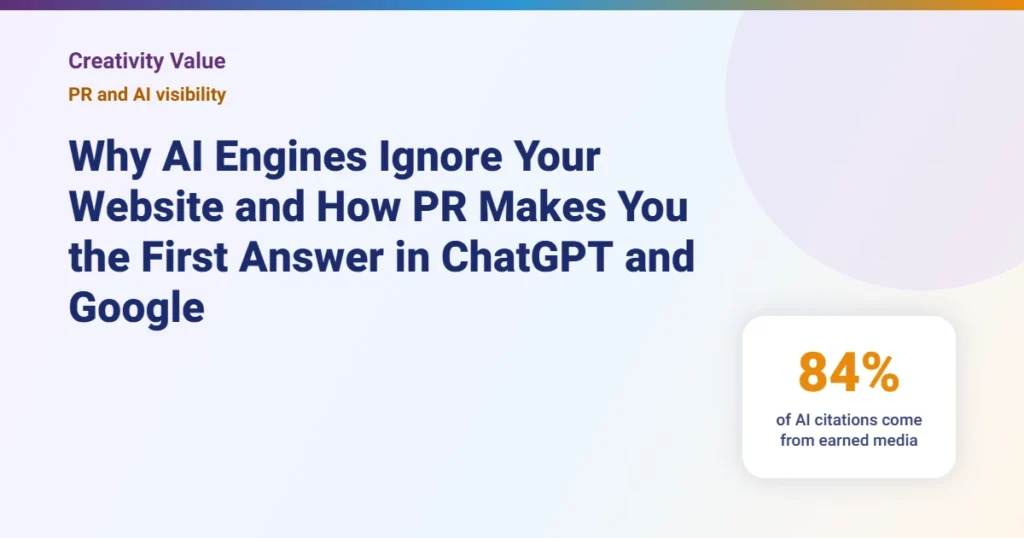
- An analysis of more than 25 million links cited in AI answers found that 84% came from earned media and only 0.3% from paid content
- In a study of 75,000 brands, web mentions correlated with AI Overview visibility at 0.664, compared with 0.218 for backlinks
- When Google shows an AI summary, clicks on a regular result drop from 15% to 8%. If you are not inside the answer, you disappear
- A consistency study of nearly 3,000 prompt runs shows the metric that matters is how often you appear, not where you rank
- For companies targeting Israel, the pool of quality sources is smaller, so each strong story in Globes, Calcalist or CTech carries more weight
What changed: from a list of links to a single answer
For twenty years digital marketing followed one logic: rank high on Google, earn the click, convert on the site. In 2026 that path is getting shorter. Google shows AI summaries above the results, ChatGPT, Gemini and Perplexity answer directly, and users get a recommendation without visiting a single site.
The business meaning is simple. The contest is no longer only for the top spot on Google but for whether the AI engine mentions you in its answer, and in what context. Seer Interactive found that brands cited inside an AI Overview earned 35% more organic clicks and 91% more paid clicks than brands that were not cited.
How does a language model decide whether to trust a company?
A language model does not believe anyone. It builds a statistical picture of the world from text, and when it searches in real time it retrieves sources and summarizes them. In both cases it shows a clear preference: independent, reputable external sources beat self-description. That is the logic of E-E-A-T, experience, expertise, authoritativeness and trust, which Google describes in its quality guidelines.
| Signal | Example | Weight for an AI engine |
|---|---|---|
| Story in a leading outlet | A CEO interview in Globes or Calcalist | Very high: an edited, independent source |
| Inclusion in a comparison list | “Top 10 tech law firms” | High: pulled straight into “who is best” questions |
| Verified reviews | Clutch, Google Business, G2 | High for buying and comparison questions |
| Wikipedia and databases | Wikipedia, Crunchbase, LinkedIn | Medium to high: confirms basic facts |
| Content on your own site | Deep guides, Q&A pages | Medium: important for details and pricing |
| Paid placement | Advertorials, banners | Negligible: 0.3% of citations |
The most comprehensive study on the subject, Muck Rack’s What Is AI Reading, examined more than 25 million links cited by ChatGPT, Claude and Gemini in May 2026. 84% were earned media: journalism, academic research, government sites and third-party content. Journalism alone made up about a quarter. Paid content barely registered.
The playbook of leading US companies: entity authority instead of keywords
In the US market the term to know is entity authority. Google and language models recognize your company as an entity, with a name, a field, people and products, and check how many independent sources connect it to a topic. The more credible sources say “Company X leads in field Y”, the more likely the AI is to say it too.
The data supports this. Ahrefs analyzed 75,000 brands and found that brand web mentions, linked or not, were the factor most strongly correlated with appearing in AI Overviews (0.664). Backlinks, the backbone of classic SEO, scored 0.218. 26% of brands studied had no mentions at all, and the top quartile by web mentions earned up to ten times more AI Overview mentions than the next quartile.
From paid clicks to mentions
Budget that went to expensive clicks moves to building presence in the outlets AI already reads.
From keywords to topics
Instead of a page per phrase, a content cluster that proves expertise across a whole subject.
From links to citations
A mention that ties your name to your field is worth more than a link with no context.
From ranking to visibility
The new metric is the share of answers you appear in, not your position.
What the experts say and what the research shows
Rand Fishkin of SparkToro, working with Gumshoe.ai, ran close to 3,000 brand recommendation prompts through ChatGPT, Claude and Google’s AI. The chance of getting the same list of brands twice was below 1 in 100, and the same order about 1 in 1,000. His conclusion: chasing a “number one spot” in an AI answer makes little sense. What you can measure and improve is how often you appear, and that is built from the volume and quality of external mentions.
Meanwhile Ahrefs’ CTR research shows that when an AI Overview appears, the top result’s click rate is 34.5% lower (April 2025), and its 2026 update put the gap at 58%. Gartner predicted in February 2024 that search engine volume would fall 25% by 2026 as users move to AI assistants.
- Correlation is not causation: strong brands get both more mentions and more AI visibility
- No trick guarantees a place in the answer. You can only raise the probability
- Your website still matters, as the source for details, pricing and FAQs
The CMO’s dilemma: immediate ROI or disappearing
The fear is familiar. PR is hard to measure in clicks, while a paid campaign shows a report tomorrow. But the comparison is misleading, because it compares a shrinking channel with a growing one.
| Paid media only | PR + GEO | |
|---|---|---|
| When the budget stops | Visibility ends the same day | Stories keep being cited |
| Presence in AI answers | Close to zero | Grows with every quality mention |
| Measurement | Clicks and conversions | Share of answers, branded search, inbound leads |
| Risk in 2027 | Rising CPC, fewer clicks | More competition for the same outlets |
The answer is not to give up on measurement but to change the metrics: your share of AI answers for the category’s key questions, branded search volume, the number of inquiries that mention “I read about you” or “ChatGPT recommended you”, and lead quality.
What this means for companies targeting Israel
Israel offers an advantage that is hard to see from outside. The pool of quality sources about Israeli companies, in Hebrew and in Israeli English-language media, is much smaller than in the US. When an AI engine looks for sources on “the best PR agency for Israeli tech” or “an Israeli law firm for cross-border deals”, it has fewer articles to choose from. A strong story in Globes, Calcalist, TheMarker or ynet, or in CTech, Globes English and The Times of Israel, carries relatively heavy weight. And with ChatGPT used by 88% of Israelis according to the Israel Internet Association’s 2026 report, the local audience is already asking these questions.
At Creativity Value we have worked this way since 2008, with more than 530 media placements for 66 clients. What changed in 2026 is that every such story is read not only by people but also by the machines that recommend you.
- The 4-Hour Window: How to Turn Breaking News Into a Direct Way Into AI Answers
- Why AI Engines Trust People More Than Logos: The Founder-Led PR Strategy of Top US CEOs
- The Click Is Dead, Long Live the Citation: How Smart Companies Cut Marketing Costs With PR and GEO
- What Does AI Say About You When a Client Asks Who to Hire? The Guide to Controlling Your Narrative in the AI Era
Frequently asked questions
What is the difference between SEO and GEO?
SEO aims to rank pages in search results. GEO, generative engine optimization, aims to get AI engines to mention and cite you inside the answer. GEO relies much more on external mentions, authority and consistent information across the web.
Do paid ads help me appear in ChatGPT?
Barely. In Muck Rack’s study of more than 25 million citations, paid and advertorial content made up only 0.3% of the sources AI engines cited.
How long until AI answers change?
Engines that search in real time, such as Perplexity and ChatGPT with search, can pick up a new story within days. A consistent change in how often you appear usually builds over three to six months of steady exposure.
How do I check whether AI recommends my company?
Define 20 to 30 questions customers ask, run each several times across several engines, and measure the share of answers you appear in. Because answers change almost every run, a single check is not enough.
Is this relevant for a small firm or a law office?
Yes. In local niches and in Hebrew, competition for mentions is lower, and a few quality stories and verified reviews can change the picture.
Want to know what AI says about you?
We will check how your company appears today in ChatGPT, Gemini and Google, and build a PR plan that puts you in the answers.
Let’s talkPR for AI visibilitySources
- Muck Rack, What Is AI Reading?, May 2026
- Ahrefs, An Analysis of AI Overview Brand Visibility Factors, May 2025
- Pew Research Center, Google users are less likely to click on links when an AI summary appears, July 2025
- Seer Interactive, AIO Impact on Google CTR: September 2025 Update
- Gartner, Search Engine Volume Will Drop 25% by 2026, February 2024
- SparkToro and Gumshoe.ai, AI recommendation consistency study, January 2026, via Search Engine Land
- Ahrefs, AI Overviews Reduce Clicks, 2025 and 2026 update
- Israel Internet Association, Israel Digital Trends 2026, via CTech
Last updated: November 2026
Want this kind of coverage for your company?
- ✓530+ media placements secured for clients in Israel and abroad
- ✓A team that came from business journalism, in the field since 2008
- ✓PR, podcasts and AI visibility under one roof
What Our Clients Say
Shoham is a pro. Period. He is determined, humble and always pushing boundaries. I met him through my podcast, and the way he pitched guests was different: he took the time to understand what really fits me, and it was clear he knows his clients in depth. Making him my go-to PR person was completely natural. I warmly recommend Shoham.
In just three months we generated very significant exposure in the leading media outlets: Globes, TheMarker, Mako and the leading podcasts in Israel. The PR activity made a real impact on our business and we received excellent feedback.

I warmly recommend Shoham to anyone looking for professional PR in finance and technology. He truly cares about his clients before, during and after the work. His professionalism is clear from the first meeting: he studies your field and niche in depth, asks the right questions and honestly presents the pros and cons of every direction. What matters most to him is your results, and he gets the best ones possible within the budget and in the shortest time imaginable.

For two years we worked with Sapir and Shoham on managing our social channels. Our exposure on social media and the connection between mortgage advisors and the association grew significantly. It was a very meaningful contribution.
The team created personal branding for our agents that few financial planners in Israel have. Articles in Calcalist, TheMarker and Globes positioned us as one of the leading financial planning firms in Israel. Clients read the articles, gain knowledge and value, and our brand stands out in the industry.
The PR and podcast activity with Shoham and his team gave us unique branding, significant real estate deals and a great deal of value. It has made a decisive contribution to our business.

Shoham and his team ran an excellent PR campaign for us. We reached all the leading media outlets, including TheMarker, Globes, Walla and Ynet, with meaningful stories that made waves. One lawsuit we publicized created a real buzz in the robotic parking market and keeps bringing new clients to the firm.
Dikla and Shoham have led our PR for several months with initiative, precision and professional understanding, and with a great many articles and podcast interviews that strongly improved our reputation and even brought in inquiries, which we did not expect at first. We recommend working with them for their persistence and commitment to success.
We have been working with Shoham and his team for several months, and they are among the most professional marketing and PR teams we have worked with. Their strategic thinking and the exposure they generated for us among potential investors opened many business opportunities and put us on the map.